
Joining the Haryana Police is not just about a job; it is a matter of pride and service for thousands of young men and women in the state. If you have grown up in the heart of Haryana, you know that the “Khaki” uniform holds a special place in our culture. The journey to wearing that uniform is challenging, especially when it comes to the physical rounds. It is often said in our villages that if you can run like the wind and stand tall, you are halfway to becoming a police officer.
Understanding the Haryana Police Selection Process
Before we dive into the physical details, let’s look at the bigger picture. The selection process for the Haryana Police has become more transparent and structured over the years. To be eligible for the physical tests, you must first clear the Common Eligibility Test (CET) for Group C.
The physical part of the recruitment is divided into two main stages:
- Physical Measurement Test (PMT): This is where your height and chest (for males) are measured using digital systems to ensure accuracy.
- Physical Screening Test (PST): This is the running test. It is qualifying in nature, meaning you just need to finish within the time limit to move to the next round.
Haryana Police Physical Measurement Test (PMT) Standards
The first thing the officials will check is whether you meet the physical growth requirements. It is a moment of high tension for many, as even a few millimeters can make a difference. These standards vary based on your category and gender.
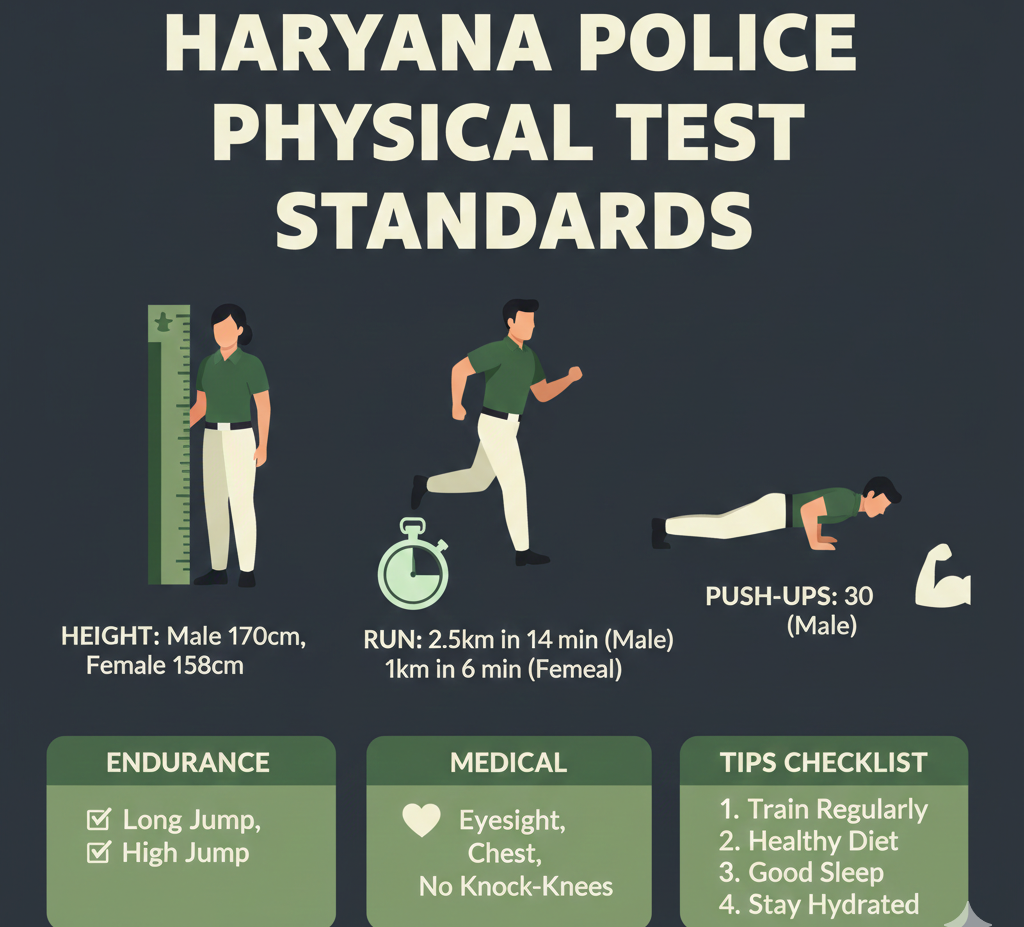
Height Requirements for Male Candidates
For the General Category, the minimum height required is 170 cm. This is the benchmark that most candidates aim for. However, there is a relaxation for those belonging to reserved categories (SC, BC, EWS) as per the state government’s latest rules. For them, the height requirement is 168 cm.
Chest Requirements for Male Candidates
The chest measurement is only for male candidates. There are two measurements: unexpanded and expanded.
- General Category: 83 cm (unexpanded) with a minimum expansion of 4 cm (reaching at least 87 cm).
- Reserved Category: 81 cm (unexpanded) with a minimum expansion of 4 cm (reaching at least 85 cm).
Height Requirements for Female Candidates
Female candidates do not have chest measurement requirements, but height is strictly checked.
- General Category: 158 cm.
- Reserved Category: 156 cm.
Important Physical Standards at a Glance
To make it easier for you to compare, here is a detailed table showing the requirements for different categories.
| Gender | Category | Minimum Height | Chest (Unexpanded) | Chest (Expanded) |
| Male | General / UR | 170 cm | 83 cm | 87 cm |
| Male | SC / BC / EWS | 168 cm | 81 cm | 85 cm |
| Female | General / UR | 158 cm | Not Applicable | Not Applicable |
| Female | SC / BC / EWS | 156 cm | Not Applicable | Not Applicable |
Haryana Police Physical Screening Test (PST): The Running Test
Once you clear the height and chest measurements, the real test of your stamina begins. The running test is designed to see if you have the endurance to handle the daily physical demands of a police officer. Unlike some other exams where running gives you extra marks, here it is purely qualifying. This means whether you finish at the very first second or the very last second of the time limit, you simply move to the next stage.
Running Standards for 2026
- For Male Candidates: You need to cover a distance of 2.5 kilometers in no more than 12 minutes.
- For Female Candidates: You need to cover 1.0 kilometer in no more than 6 minutes.
- For Ex-Servicemen: The distance is 1.0 kilometer, but the time limit is tighter at 5 minutes.
These tests usually employ RFID (Radio Frequency Identification) technology. A small chip is attached to your chest or shoe, and it records the exact moment you cross the start and finish lines. This removes any human error or bias, making the process fair for everyone.
Latest News Updates for Haryana Police Recruitment 2026
Staying updated with the latest figures and dates is essential for any serious candidate. As of early 2026, the Haryana Staff Selection Commission (HSSC) has been very active in processing the latest vacancies.
- Total Vacancies: The HSSC has officially notified 5,500 vacancies for the post of Constable. This includes 4,500 posts for Male Constables (General Duty), 600 for Female Constables, and 400 for Male Constables in the Government Railway Police (GRP).
- Age Relaxation News: In a major relief for many aspirants, the Haryana Government recently granted a 3-year age relaxation across all categories for the 2026 recruitment cycle. This means the upper age limit for General category candidates is now effectively 28 years instead of 25.
- Application Timeline: The online application window which opened in January 2026 has recently closed on January 31, 2026. Thousands of CET-qualified candidates have applied, and the dates for the PMT and PST are expected to be announced shortly.
- Weightage Changes: The “Knowledge Test” or written exam now carries a weightage of 94.5 marks, while additional marks (up to 3) are awarded for NCC certificates.
Practical Preparation Tips for the Physical Test
Knowing the standards is one thing, but meeting them requires sweat and discipline. I have seen many fit individuals fail because they underestimated the “12-minute” rule or didn’t know how to expand their chest properly. Here are some tips to help you prepare effectively.
1. Mastering the Run
Running 2.5 kilometers sounds easy on paper, but on the day of the test, with hundreds of others around you, it can be daunting.
- Start Slow: Don’t try to run 2.5 km on day one. Start with a brisk walk, then move to a slow jog for 15 minutes. Gradually increase your pace over 4-6 weeks.
- Interval Training: Once a week, try “sprint-rest” cycles. Run very fast for 200 meters, then walk for 100 meters. This builds the lung capacity needed for that final stretch.
- The Right Surface: If possible, practice on a ground or track rather than a concrete road. Concrete is hard on the knees and can lead to “shin splints” (pain in the lower leg), which might sideline you just before the test.
- Breathing Technique: Try to breathe in through your nose and out through your mouth. Shallow breathing will make you tire out faster.
2. Increasing Chest Expansion
For male candidates, the 4 cm expansion is often harder than the actual chest size.
- Push-ups are Key: Do at least 3 sets of 20 push-ups daily. This strengthens the pectoral muscles and improves flexibility.
- Pranayama: Deep breathing exercises like Anulom Vilom help in increasing the capacity of your lungs, making it easier to expand your ribcage during the measurement.
- The Correct Posture: During the measurement, don’t just “puff” your chest. Focus on pulling your shoulder blades back slightly and filling your lungs from the bottom up.
3. Maintaining the Right Height and Weight
While you cannot change your height, you can ensure you are not “losing” any height due to poor posture.
- Posture Correction: Practice standing against a wall with your heels, buttocks, and head touching the surface. This ensures you stand at your full height during the PMT.
- Weight Management: While there is no specific weight limit mentioned, being overweight will make the running test much harder and put pressure on your joints. Aim for a healthy BMI (Body Mass Index).
4. Diet and Hydration
What you put into your body is the fuel for your performance.
- Hydrate: Drink plenty of water, especially during the summer months in Haryana. Dehydration causes cramps.
- Natural Protein: Include chana (gram), moong dal, and milk in your diet. These are traditional Haryanvi staples that provide excellent muscle recovery.
- Avoid Junk: In the month leading up to the test, stay away from oily street food. A stomach upset a week before the PST can ruin months of hard work.
Common Mistakes to Avoid
- Over-training: Don’t run twice a day every day. Your muscles need rest to grow stronger. Give yourself at least one full day of rest every week.
- Using New Shoes on Test Day: Never wear a brand-new pair of shoes on the day of the PST. New shoes can cause blisters. Always break in your shoes for at least two weeks before the test.
- Skipping the Warm-up: Many candidates start running as soon as they reach the track. This leads to muscle pulls. Spend 10 minutes doing dynamic stretches like leg swings and arm circles.
Documents to Carry for the Physical Test
When you are called for the PMT/PST, make sure you have your paperwork in order. Usually, you will need:
- Admit Card: Downloaded from the official HSSC portal.
- Identity Proof: Aadhaar Card, Voter ID, or Driving License.
- CET Scorecard: Proof that you are eligible for the next round.
- Category Certificate: If you are claiming relaxation in height or chest.