
I will walk you through everything you need to know about the Haryana government job promotion policy. This information is especially useful for aspiring and current government employees, job seekers, and families planning career paths in public service.
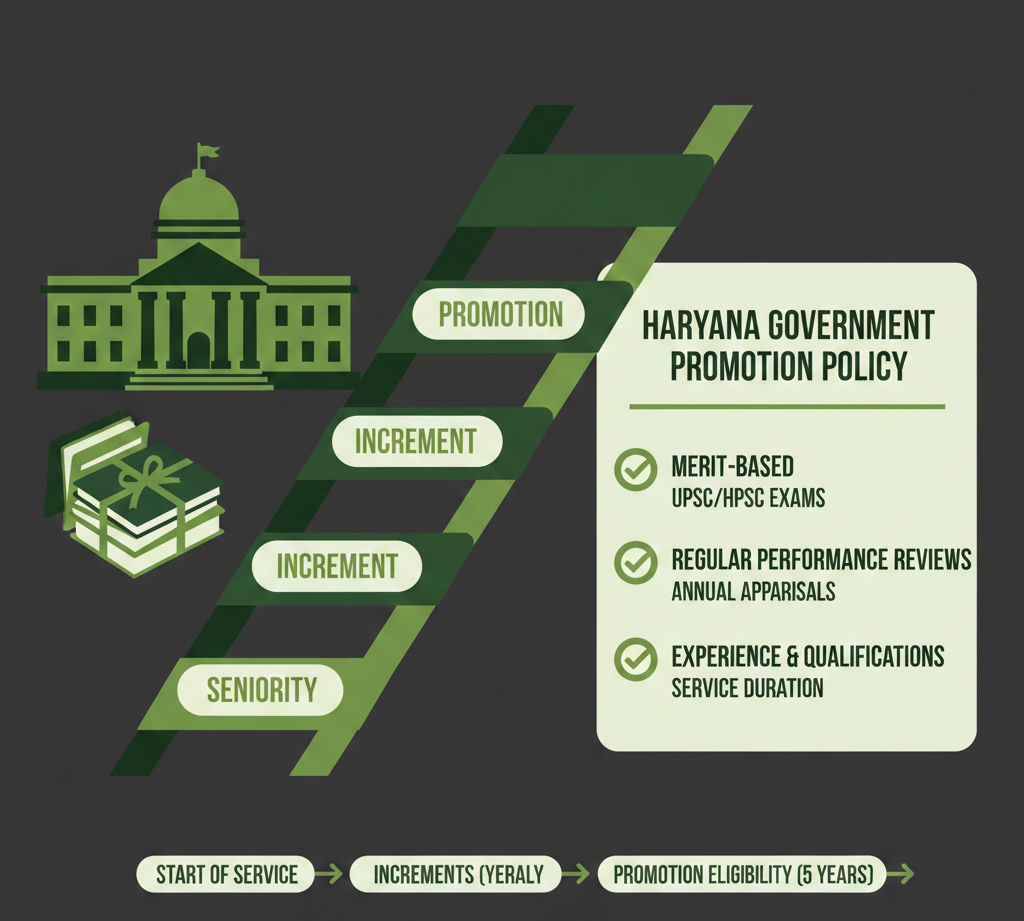
Understanding Government Promotions in Haryana
Promotion in a government job means moving to a higher position with more responsibilities, better pay, and improved status. In Haryana, promotion policies are guided by the Haryana Civil Services Rules, various departmental guidelines, and decisions by courts when disputes arise.
The process is often driven by:
1. Seniority
This is how long you have served in a position or cadre.
2. Merit & Performance
Assessment of your work through reports and evaluations.
3. Time served in grade
Most promotions follow a minimum number of years in a given position.
In simple terms, if you have served longer and performed well, you are more likely to get promoted — but rules also ensure fairness so that deserving employees aren’t left behind.
What Affects Job Promotion in Haryana? A Simple Breakdown
The promotion system considers a number of factors:
Seniority —
Seniority means your date of regular appointment compared to others in the same cadre. When promotions are considered, seniority lists help decide who is ahead in line. However, seniority alone does not guarantee promotion unless other criteria are met.
Performance Appraisal Reports —
Every government employee gets an Annual Performance Appraisal Report (APAR). This report tells how well someone has performed. Courts have said that a single mediocre grading cannot block promotion of a long-serving official with an otherwise strong service record.
Departmental Exams or Tests —
For some posts, a departmental exam is part of the process. If you pass, it adds to your eligibility for promotion.
Time Served in Grade —
Before being considered for promotion, you typically need to serve a minimum number of years in your current position. Specific numbers vary by department and rank.
Special Government Orders —
Sometimes the Haryana government issues special promotion orders. For example, several thousand officials received benefit under old promotion orders that were revived.
Seniority and Merit: How Do They Work Together?
One of the most common questions employees ask is:
“Does seniority always mean promotion?”
The honest answer is — not always. While seniority is important, Haryana rules usually promote on a seniority-cum-merit basis. This means:
- If employee A is senior but scored lower on merit (performance), and employee B is junior but has higher merit, the final promotion order may favour a balance between the two.
- Courts have intervened when bonus marks or socio-economic points were wrongly used to determine seniority or promotion order. In fact, the High Court directed authorities to remove bonus marks (extra marks) from promotional consideration because they were unconstitutional in seniority lists.
This policy encourages fair competition and equal opportunity.
How Often Do Increments and Promotion Reviews Happen?
Government employees get annual increments — this means an increase in salary based on experience with each completed year of service. For example, if a person joins on July 2, he/she can get the next increment on July 1 after completing one full year.
Interestingly, the High Court of Punjab & Haryana said that even if a government employee retires on June 30, he or she is still entitled to the annual increment due on July 1, as long as they completed the qualifying service year.
That’s why it’s important to know your increment cycle and how it interacts with your promotion timeline.
Assured Career Progression (ACP) and Other Benefits
To make sure employees do not face career stagnation, Haryana offers Assured Career Progression (ACP) in several departments. ACP provides promotions or pay benefits at specific intervals regardless of regular promotions.
In unique cases — like disputes with direct recruitment versus promotion paths — the government has agreed to revise the ACP structure. For example, doctors protested a recruitment policy that could hurt promotions and the government agreed to revise ACP benefits.
Important Rules You Should Know (Quick Reference)
| Rule/Area | What It Means | Why It Matters |
|---|---|---|
| Seniority Basis | Order of appointment determines ranking | Helps decide promotional forwarding |
| Merit Consideration | Performance evaluations and exams count | Ensures quality in promotions |
| Blocked Promotion Protection | Courts protect employees from single bad APAR entries | Encourages fairness in evaluations |
| Annual Increments | Pay increases based on service completed | Boosts salary over time |
| ACP Provisions | Guaranteed career progression | Prevents stagnation even if regular promotion is delayed |
| Group-D Upward Movement | Reserved quotas for certain promotional posts | Allows entry-level workers to rise |
Common Promotion Scenarios You May Experience
Many employees ask me how it works in real life. Here are a few typical paths:
Scenario 1: Clerk to Senior Clerk
A clerk who has worked five years and scored well in performance reports becomes eligible for senior clerk. Seniority and merit lists determine the exact order.
Scenario 2: Group-D to Group-C Promotion
Recently, departments like Excise & Taxation have announced that 30% of vacant driver/Group-C seats will be filled through promotions from Group-D, giving many clerical and support staff new opportunities.
Scenario 3: ACP Benefits without Test
Employees who struggle to clear departmental exams can still benefit through assured career progression, ensuring pay upgrades at fixed service points.
Latest News Updates (Real and Relevant)
Here is the most updated information as of early 2026, crucial to government employees in Haryana:
- Job Promotion Ruling by High Court: A key decision by the Punjab & Haryana High Court said that one average performance grade cannot block promotions, protecting long-serving employees’ rights and calling for reconsideration of blocked promotions.
- Seniority List Revision Order: Separate court action directed that bonus marks cannot be used to calculate seniority or promotion ranks, reinforcing merit-only promotion lists.
- HPSC Promotion and Career Paths: The Haryana Public Service Commission (HPSC) has released the Civil Services exam notification for 2026. While this is a recruitment update, it ties into future promotions for administrative roles like DSP, SDM and other posts.
- ACP Strikes and Policy Changes: Doctors in government service called off a strike after the government agreed to revise Assured Career Progression benefits, highlighting the value of ACP in promotion policy.
These developments show that the policy environment is dynamic and often touches on legal rulings, administrative reforms, and employee movement rules — all of which affect promotions.
Tips to Improve Your Promotion Chances
Having been part of government service for years, here are a few tips that helped colleagues and me:
- Keep your APAR performance strong: Avoid negative remarks. If there’s a lower score, ensure you communicate and clarify.
- Stay updated with departmental notices: Promotions often depend on vacancy data provided by each department.
- Prepare for departmental exams: For posts that require tests, begin early and practice regularly.
- Complete service milestones: Timely completion of qualifying years is essential for both increments and promotion cycles.
- Make use of ACP: Even if regular promotion is delayed, ACP helps maintain career growth.
Common Mistakes to Avoid
As you grow in your career, be cautious of:
- Ignoring official communications
- Delaying departmental tests
- Assuming seniority alone guarantees promotion
- Not understanding the impact of court decisions on promotions
Staying informed, proactive, and engaged with the HR policies can make your journey smoother.
Conclusion — Your Career Path in Government Service Matters
In Haryana, government job promotion policy is built to balance fair seniority, merit performance, and structured progression. Whether you are a young recruit or a long-serving employee, knowing how promotions work — and keeping track of the latest policy changes or legal rulings — is key to your career growth.