
In the heart of North India, Haryana is a state known not just for its sprawling wheat fields and world-class athletes, but also for its competitive spirit when it comes to government jobs. If you are a resident of Haryana, you know that a “Sarkari Naukri” is more than just a paycheck; it is a mark of pride and stability for the entire family. However, the path to these jobs often feels like a maze of rules, categories, and changing policies.
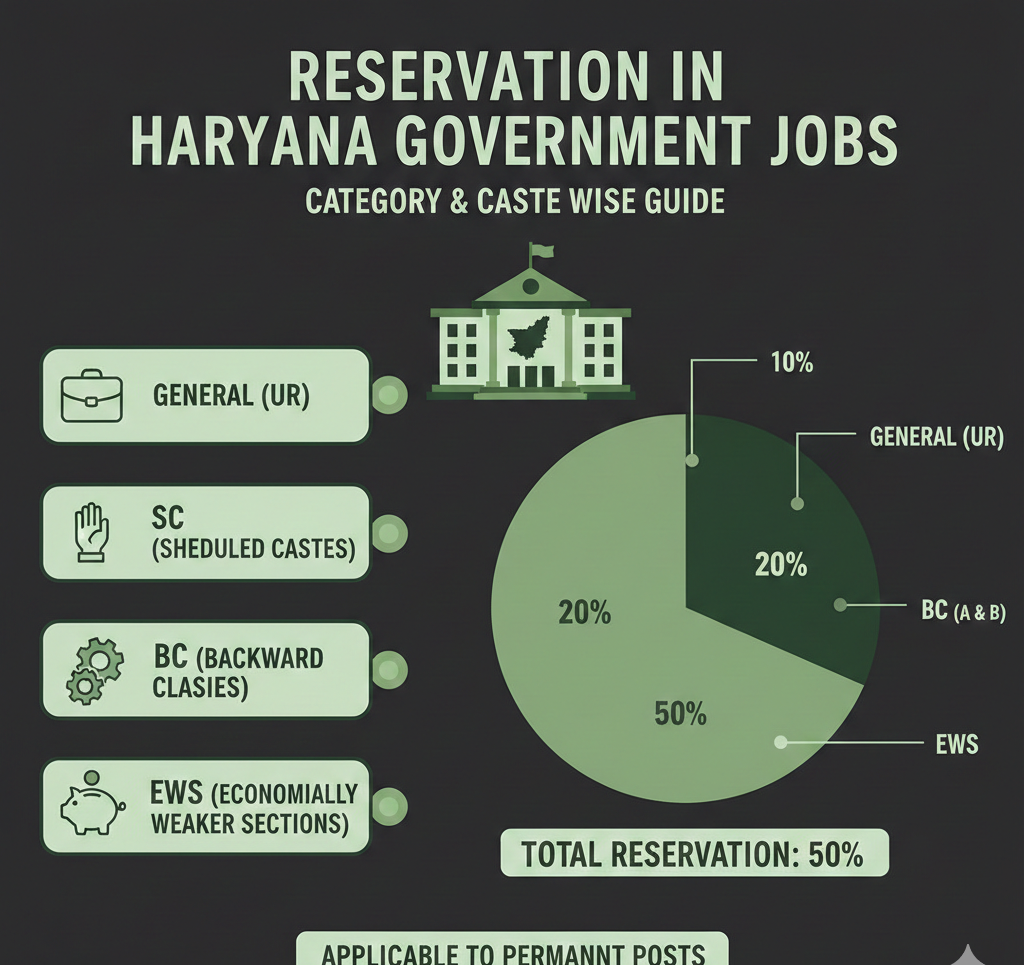
Understanding how reservation works in the Haryana government is essential for every aspirant. Whether you are from the Scheduled Castes, Backward Classes, or the General category looking for EWS benefits, knowing your rights and the latest quotas can make a significant difference in your preparation strategy.
A Simple Breakdown of Reservation Categories
In Haryana, reservation is divided into several buckets. The state follows a policy that aims to give a helping hand to those who have historically been left behind.
- Scheduled Castes (SC): This category is further divided into “Deprived Scheduled Castes” and “Other Scheduled Castes” to ensure that the most marginalized among the SCs get their fair share.
- Backward Classes (BC): This is split into Block A (BC-A) and Block B (BC-B), depending on the socio-economic status of the specific castes.
- Economically Weaker Sections (EWS): This is for the General category candidates who do not fall under SC or BC but come from families with limited financial means.
- Ex-Servicemen (ESM): A special salute to those who served in the armed forces, providing them and sometimes their dependents a quota in state jobs.
- Persons with Benchmark Disabilities (PwBD): Ensuring that physical challenges do not stand in the way of a professional career.
Understanding the Numbers: Current Reservation Percentages
To keep things clear, let’s look at how many seats are actually kept aside for each group in a typical recruitment drive for Haryana state services.
Reservation Quota Table for Haryana Government Jobs
| Category | Reservation Percentage | Key Highlights |
| Scheduled Castes (SC) | 20% | Split into 10% for Deprived SC and 10% for Other SC. |
| Backward Classes – Block A (BC-A) | 16% | Covers a wide range of smaller artisan and labor communities. |
| Backward Classes – Block B (BC-B) | 11% | Includes communities that are relatively more represented. |
| Economically Weaker Section (EWS) | 10% | For General category residents meeting income/asset criteria. |
| Ex-Servicemen (ESM) | 5% to 14% | Varies based on the Group (Group A, B, C, or D) of the post. |
| Persons with Disabilities (PwBD) | 4% | Horizontal reservation across all categories. |
The Recent Shift in Scheduled Caste (SC) Reservation
One of the most significant changes in recent times is the sub-classification of the 20% SC quota. The Haryana government, following a landmark Supreme Court ruling, decided that within the 20% reserved for SCs, 50% of those seats (which is 10% of the total) must go to “Deprived Scheduled Castes” (DSC).
What does this mean for you?
If you belong to castes like the Balmiki, Dhanak, or Mazhabi Sikh, you now have a dedicated space within the SC quota. If candidates from the DSC category are not available, only then can those seats be filled by candidates from the “Other Scheduled Castes” (like the Chamar or Rahgar communities). This ensures that the benefits of reservation reach the “last person in the line.”
Backward Classes: The A and B Blocks
The Backward Classes in Haryana are not a single block.
- BC-A: This block contains over 70 castes. They get 16% reservation.
- BC-B: This block contains fewer castes (like Ahir/Yadav, Saini, Gujjar) and gets 11% reservation.
The “Creamy Layer” rule applies here. If your family income exceeds a certain limit (currently ₹6 lakh per annum in many cases, though check specific ads for updates), you are treated as a General category candidate and cannot claim the BC benefit.
EWS: A New Door for the General Category
For a long time, many families in the General category felt left out because of their financial struggles. The EWS quota changed that.
- Income Limit Update: As of early 2026, the Haryana government has aligned its EWS criteria with the Central Government, raising the family income ceiling to ₹8 lakh per annum.
- Asset Rules: Besides income, there are rules about how much land or house you can own. If you have more than 5 acres of agricultural land, you might not qualify for EWS even if your income is low.
Latest News Updates (As of February 2026)
Staying updated is the key to a successful application. Here are the most recent developments in Haryana’s recruitment and reservation landscape:
- EWS Income Hike: On January 14, 2026, the state officially increased the annual income limit for EWS candidates from ₹6 lakh to ₹8 lakh. This change is now applicable to all new HSSC and HPSC advertisements.
- HSSC CET Group C Phase-II: New advertisements (like Advt. 02/2026) have been released for Group C posts. Candidates who qualified for the Common Eligibility Test (CET) are now applying with the updated DSC and OSC classifications.
- Contractual Employee Portal: The government has extended the timeline for contractual employees to register on the CS Haryana portal to secure their service data, which may impact future regularizations and weightage.
- Private Sector Quota Status: The previous law providing 75% reservation for locals in private jobs remains under heavy legal scrutiny. While the High Court had quashed it, the state continues to explore ways to prioritize local youth in the industrial sector within constitutional limits.
- Age Relaxations: For most Group C and D jobs, the upper age limit remains 42 years, but SC and BC candidates get an additional 5-year relaxation, making it 47 years.
How to Apply Correctly Without Making Mistakes
I have seen many brilliant students lose their chance because of a simple document error. Don’t let that be you.
- The “Parivar Pehchan Patra” (Family ID): In Haryana, your Family ID is the most important document. Ensure your income is correctly verified in the PPP portal, as the EWS and BC benefits are often pulled directly from this data.
- Certificate Validity: Many certificates (like EWS or BC Non-Creamy Layer) need to be issued within the current financial year. Always check the “cut-off date” in the job advertisement.
- Socio-Economic Marks: Haryana gives extra marks (usually 2.5% to 5%) for candidates who have no one in their family in a government job. Be very honest here; the government does physical verification, and a wrong claim can lead to a permanent ban from exams.
Checklist for Haryana Job Aspirants:
- [ ] Verify your income in the Parivar Pehchan Patra (PPP).
- [ ] Renew your Category Certificate if it’s older than a year.
- [ ] Keep your Domicile Certificate ready (you must be a resident of Haryana for these benefits).
- [ ] Regularly check the official HSSC and HPSC websites.
Conclusion
Reservation in Haryana government jobs is a multi-layered system that reflects the state’s diverse social fabric. By categorizing SCs into DSC and OSC, and providing clear paths for BC-A, BC-B, and EWS candidates, the government attempts to distribute opportunities fairly. With the recent increase in the EWS income limit to ₹8 lakh and the ongoing CET recruitment cycles, 2026 is a massive year for job seekers in the state.
Stay informed, keep your documents ready, and most importantly, keep your spirits high. Your dream of a Haryana government job is closer than you think.